Postmodern Research Evaluation? | 1 of ?

This will be the first is a series of posts tagged ‘postmodern research evaluation’ — a series meant to be critical and normative, expressing my own, subjective, opinions on the question.

Before I launch into any definitions, take a look at this on ‘Snowball Metrics‘. Reading only the first few pages should help orient you to where I am coming from. It’s a place from where I hope to prevent such an approach to metrics from snowballing — a good place, I think, for a snowball fight.

Read the opening pages of the snowball report. If you cannot see this as totalizing — in a very bad way — then we see things very differently. Still, I hope you read on, my friend. Perhaps I still have a chance to prevent the avalanche.

Broader Impacts and Intellectual Merit: Paradigm Shift? | NOT UNTIL YOU CITE US!

On the one hand, this post on the VCU website is very cool.  It contains some interesting observations and what I think is some good advice for researchers submitting and reviewing NSF proposals.

Broader Impacts and Intellectual Merit: Paradigm Shift? | CHS Sponsored Programs.

On the other hand, this post also illustrates how researchers’ broader impacts go unnoticed.

One of my main areas of research is peer review at S&T funding agencies, such as NSF. I especially focus on the incorporation of societal impact criteria, such as NSF’s Broader Impacts Merit Review Criterion. In fact, I published the first scholarly article on broader impacts in 2005. My colleagues at CSID and I have published more than anyone else on this topic. Most of our research was sponsored by NSF.

I don’t just perform research on broader impacts, though. I take the idea that scholarly research should have some impact on the world seriously, and I try to put it into practice. One of the things I try to do is reach out to scientists, engineers, and research development professionals in an effort to help them improve the attention to broader impacts in the proposals they are working to submit to NSF. This past May, for instance, I traveled down to Austin to give a presentation at the National Organization for Research Development Professionals Conference (NORDP 2013). You can see a PDF version of my presentation at figshare.

If you look at the slides, you may recognize a point I made in a previous post, today. That point is that ‘intellectual merit’ and ‘broader impact’ are simply different perspectives on research. I made this point at NORDP 2013, as well, as you can see from my slides. Notice how they put the point on the VCU site:

Broader Impacts are just another aspect of their research that needs to be communicated (as opposed to an additional thing that must be “tacked on”).

I couldn’t have said it better myself. Or perhaps I could. Or perhaps I did. At NORDP 2013.

Again, VCU says:

Presenters at both conferences [they refer to something called NCURA, with that hyperlink, and to NORDP, with no hyperlink] have encouraged faculty to take the new and improved criteria seriously, citing that Broader Impacts are designed to answer accountability demands.  If Broader Impacts are not carefully communicated so that they are clear to all (even non-scientific types!), a door could be opened for more prescriptive national research priorities in the future—a move that would limit what types of projects can receive federal funding, and would ultimately inhibit basic research.

Unless someone else is starting to sound a lot like us, THIS IS OUR MESSAGE!

My point is not to claim ownership over these ideas. If I were worried about intellectual property, I could trademark a broader impacts catch phrase or something. My point is that if researchers don’t get any credit for the broader impacts of their research, they’ll be disinclined to engage in activities that might have broader impacts. I’m happy to share these ideas. How else could I expect to have a broader impact? I’ll continue to share them, even without attribution. That’s part of the code.

To clarify: I’m not mad. In fact, I’m happy to see these ideas on the VCU site (or elsewhere …). But would it kill them to add a hyperlink or two? Or a name? Or something? I’d be really impressed if they added a link to this post.

I’m also claiming this as evidence of the broader impacts of my research. I don’t have to contact any lawyers for that, do I?

UPDATE: BRIGITTE PFISTER, AUTHOR OF THE POST TO WHICH I DIRECTED MY DIATRIBE, ABOVE, HAS RESPONDED HERE. I APPRECIATE THAT A LOT. I ALSO LEFT A COMMENT APOLOGIZING FOR MY TONE IN THE ABOVE POST. IT’S AWAITING MODERATION; BUT I HOPE IT’S ACCEPTED AS IT’S MEANT — AS AN APOLOGY AND AS A SIGN OF RESPECT.

Calling All Thinkers — a plea for fostering diversity in thought

I am concerned that our educational system is blocking photorealistic visual thinkers like me from careers in science. Instead, we should encourage diversity in modes of thinking so that we aren’t losing the special talents of people who might contribute greatly to research and development by offering unique perspectives.

Calling All Thinkers | The Scientist Magazine®.

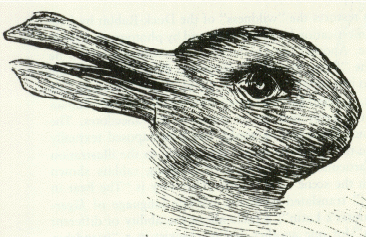
This is a good read. I do wish it included an image, though, beyond a photo of the author’s book cover. I often use images to try to make a similar point — that the question of impact is really a question of looking at different aspects of research, for instance. Here’s my go-to image for that claim:

Jastrow's Duck-Rabbit

It’s a simple point, but figuring out how to make it is difficult. I’m actually a big fan of the idea of involving the body somehow. I think this sort of perceptual shift is connected with our kinesthetic sense — it’s something we have to experience or feel.

If you care to get a sense of how I think, it’s shown by the ‘fact’ that I think these observations, above, are connected to both the Humboldtian idea of linking research and teaching and to my push to extend our thinking about altmetrics well beyond article-level metrics of even many different types of scholarly communication.

A pragmatic guide to monitoring and evaluating research communications using digital tools

Great blog for anyone interested in telling their own impact story!

Nigel Warburton’s negative vision of what philosophy isn’t

Philosopher Nigel Warburton, of philosophy bites fame, has just resigned his academic post at the Open University to pursue other opportunities. The Philosopher’s Magazine conducts an extended interview with Warburton here. Much of what he reveals in this interview is both entertaining and, in my opinion, true.

But one aspect of the interview especially caught my attention. After offering several criticisms of academic philosophy today with which I’m in total agreement (in particular the tendency of hiring committees to hire clones of themselves rather than enhancing the diversity of the department), Warburton offers what he seems to view as the ultimate take down of academic philosophy. I quote this section in full, below. If you’ve been paying any attention to this blog or our posts at CSID, you’ll understand why, immediately.

He reserves particular venom for the REF, the Research Excellence Framework, a system of expert review which assesses research undertaken in UK higher education, which is then used to allocate future rounds of funding. A lot of it turns on the importance of research having a social, economic or cultural impact. It’s not exactly the sort of thing that philosophical reflection on, say, the nature of being qua being is likely to have. He leans into my recorder to make sure I get every word:

“One of the most disturbing things about academic philosophy today is the way that so many supposed gadflies and rebels in philosophy have just rolled over in the face of the REF – particularly by going along with the idea of measuring and quantifying impact,” he says, making inverted commas with his fingers, “a technical notion which was constructed for completely different disciplines. I’m not even sure what research means in philosophy. Philosophers are struggling to find ways of describing what they do as having impact as defined by people who don’t seem to appreciate what sort of things they do. This is absurd. Why are you wasting your time? Why aren’t you standing up and saying philosophy’s not like that? To think that funding in higher education in philosophy is going to be determined partly by people’s creative writing about how they have impact with their work. Just by entering into this you’ve compromised yourself as a philosopher. It’s not the kind of thing that Socrates did or that Hume did or that John Locke did. Locke may have had patrons, but he seemed to write what he thought rather than kowtowing to forces which are pushing on to us a certain vision, a certain view of what philosophical activities should be. Why are you doing this? I’m getting out. For those of you left in, how can you call yourselves philosophers? This isn’t what philosophy’s about.”

Please tell us how you really feel, Dr. Warburton.

In the US, we are not subject to the REF. But we are subject to many, many managerial requirements, including, if we seek grant funding, the requirement that we account for the impact of our research. We are, of course, ‘free’ to opt out of this sort of requirement simply by not seeking grant funding. Universities in the UK, however, are not ‘free’ to opt out of the REF. So, are the only choices open to ‘real’ philosophers worthy of the name resistance or removing oneself from the university, as Warburton has chosen?

I think not. My colleagues and I recently published an article in which we present a positive vision of academic philosophy today. A key aspect of our position is that the question of impact is itself a philosophical, not merely a technical, problem. Philosophers, in particular, should own impact rather than allowing impact to be imposed on us by outside authorities. The question of impact is a case study in whether the sort of account of freedom as non-domination offered by Pettit can be instantiated in a policy context, in addition to posited in political philosophy.

Being able to see impact as a philosophical question rests on being able to question the idea that the only sort of freedom worth having is freedom from interference. If philosophy matters to more than isolated individuals — even if connected by social media — then we have to realize that any philosophically rich conception of liberty must also include responsibility to others. Our notion of autonomy need not be reduced to the sort of non-interference that can only be guaranteed by separation (of the university from society, as Humboldt advocated, or of the philosopher from the university, as Warburton now suggests). Autonomy must be linked to accountability — and we philosophers should be able to tackle this problem without being called out as non-philosophers by someone who has chosen to opt out of this struggle.

Ross Mounce lays out easy steps towards open scholarship | Impact of Social Sciences

Excellent post with lots of good information here;

Easy steps towards open scholarship | Impact of Social Sciences.

There are some especially good thoughts about preprints.

Ross is right, I think, that using preprints is uncommon in the Humanities. For anyone interested in exploring the idea, I recommend the Social Epistemology Review and Reply Collective. Aside from being one of the few places to publish preprints in the Humanities, the SERRC preprints section also allows for extended responses to posted preprints, such as this one. The one major drawback (as Ross points out about sites such as Academia.edu) is that the SERRC doesn’t really archive preprints in the way that, say, a library would. Of course, if you happen to have an institutional repository, you can use that, as well.

Another site worth mentioning in this context is peerevaluation.org. I posted the same preprint on my page there. There are two interesting features of the peerevaluation.org site. One is that it uses interesting metrics, such as the ‘trust’ function. Similar to Facebook ‘likes’, but much richer, the ‘trust’ function allows users to build a visible reputation as a ‘trusted’ reviewer. What’s that, you ask? As a reviewer? Yes, and this is the second interesting feature of peerevaluation.org. It allows one to request reviews of posted papers. It also keeps track of who reviewed what. In theory, this could allow for something like ‘bottom-up’ peer review by genuine peers. One drawback of peerevaluation.org is that not enough people actually participate as reviewers. I encourage you to visit the site and serve as a reviewer to explore the possibilities.

As a humanist who would like to take advantage of preprints, both to improve my own work and for the citation advantage Ross notes, it’s difficult not to envy the situation in Physics and related areas (with arxiv). But how does such a tradition start? There are places one can use to publish preprints in the humanities. We need to start using them.

On British higher education’s Hayek appreciation club | Stian Westlake | Science | guardian.co.uk

British higher education’s Hayek appreciation club | Stian Westlake | Science | guardian.co.uk.

I think Stian Westlake is on to something here, though I think the explanation goes deeper than British academics’ secret memberships in the Hayek Appreciation Club (HAC).

Before any academic is considered for membership in the HAC, she first must become a super secret member of the super secret Humboldt Alliance (SSHA, or just HA for short). It was Humboldt, after all, who argued not only that research and teaching should be integrated in the person of the professor (a claim I support), but also that the university must be autonomous from the state (a claim I question, to a degree).

Underlying Humboldt’s demand for autonomy is a view Isaiah Berlin termed negative liberty. Briefly, negative liberty entails freedom from constraint or interference. Positive liberty, on the other hand, allows some interference insofar as such interference may actually allow us to exercise our freedom on our own terms. For those who espouse negative liberty — including not only Humboldt and Hayek, but also Popper (mentored by Hayek) and Berlin himself — autonomy means laissez faire. For those who espouse positive liberty — including Kant, Hegel, and Marx — autonomy means self-determination.

Humboldt also held the view that the state will actually benefit more if it leaves the university alone than if it attempts to direct the course of research in any way. I discuss similarities with Vannevar Bush, the father of US science policy, here. But the same argument gets recycled every time any policy maker suggests any interest in the affairs of the university.

Before there was a Hayek Appreciation Club, Hayek was a member of the Super Secret Humboldt Association. I’m pretty sure that Humboldt was also a member of the Super Double Secret Lovers of Aristotle Foundation (LAF); but that’s difficult to prove. Nevertheless, it was Aristotle who laid the foundation for Humboldt in arguing that what is done for its own sake is higher than what is done for the sake of something else. Aristotle also thought that the life of contemplation (a.k.a. philosophy) was better for the philosopher than any other life. But he didn’t take it as far as Humboldt and argue that it was also better for society.

To me, there’s a relation to this post on the CSID blog, as well.

Quick thoughts on Challenges of Measuring Social Impact Using Altmetrics

As altmetric data can detect non-scholarly, non-traditional modes of research consumption, it seems likely that parties interested in social impact assessment via social reach may well start to develop altmetric-based analyses, to complement the existing approaches of case histories, and bibliometric analysis of citations within patent claims and published guidelines.

This and other claims worth discussing appear in this hot-off-the-presses (do we need another metaphor now?) article from Mike Taylor (@herrison):

The Challenges of Measuring Social Impact Using Altmetrics – Research Trends.

In response to the quote above, my own proposal would be to incorporate altmetrics into an overall narrative of impact. In other words, rather than have something like a ‘separate’ altmetric report, I’d rather have a way of appealing to altmetrics as one form of empirical evidence to back up claims of impact.

Although it is tempting to equate social reach (i.e., getting research into the hands of the public), it is not the same as measuring social impact. At the moment, altmetrics provides us with a way of detecting when research is being passed on down the information chains – to be specific, altmetrics detects sharing, or propagation events. However, even though altmetrics offers us a much wider view of how scholarly research is being accessed and discussed than bibliometrics, at the moment the discipline lacks an approach towards understanding the wider context necessary to understand both the social reach and impact of scholarly work.

Good point about the difference between ‘social reach’ and ‘social impact’. My suggestion for developing an approach to understanding the link between social reach and social impact would be something like this: social reach provides evidence of a sort of interaction. What’s needed to demonstrate social impact, however, is evidence of behavior change. Even if one cannot establish a direct causal relation between sharing and behavior change, demonstrating that one’s research ‘reached’ someone who then changed her behavior in ways consistent with what one’s paper says would generate a plausible narrative of impact.


Although altmetrics has the potential to be a valuable element in calculating social reach – with the hope this would provide insights into understanding social impact – there are a number of essential steps that are necessary to place this work on the same standing as bibliometrics and other forms of assessment.

My response to this may be predictable, but here goes anyway. I am all for improving the technology. Using Natural Language Processing, as Taylor suggests a bit later, sounds promising. But I think there’s a fundamental problem with comparing altmetrics to bibliometrics and trying to bring the former up to the standards of rigor of the latter. The problem is that this view privileges technology and technical rigor over judgment. Look, let’s make altmetrics as rigorous as we can. But please, let’s not make the mistake of thinking we’ve got the question of impact resolved once altmetrics have achieved the same sort of methodological rigor as bibliometrics! The question of impact can be answered better with help from technology. But to assume that technology can answer the question on its own (as if it existed independently of human beings, or we from it), is to fall into the trap of the technological fix.

On Learning from Peer Review | Extending ‘Peers’ to Include non-Academics

Absent from the many analyses and discussions of scientific peer review are two intangible but very important byproducts: 1) feedback to the applicant and 2) exposure of the reviewers to new hypotheses, techniques, and approaches. Both of these phenomena have a virtual mentoring effect that helps move science forward. Such learning can occur as a consequence of both manuscript review and grant application review, but the review of grant applications, by its very nature, is more iterative and impacts the direction in which research moves very early in the investigation.

Opinion: Learning from Peer Review | The Scientist Magazine®.

There are at least two funding agencies that recognize this phenomenon in the actual design of their peer review processes, so they deserve mention. The idea is to include non-academics as peer reviewers precisely to effect the sort of co-production of knowledge the article above suggests.

The first is STW, the Dutch Technology Foundation. I outline their peer review process in this article, available Open Access.

The second is the US Congressionally Directed Medical Research Program. Details of their peer review process are available on their website here.

San Francisco Declaration on Research Assessment — Well done, DORA

Anyone interested in research assessment should read this with care.

DORA.

It’s been presented in the media as an insurrection against the use of the Journal Impact Factor — and the Declaration certainly does … ehr … declare that the JIF shouldn’t be used to assess individual researchers or individual research articles. But this soundbite shouldn’t be used to characterize the totality of DORA, which is much broader than that.

Honestly, it took me a few days to go read it. After all, it’s uncontroversial in my mind that the JIF shouldn’t be used in this way. So, an insurrection against it didn’t strike me as all that interesting. I’m all for the use of altmetrics and — obviously, given our recent Nature correspondence (free to read here) — other inventive ways to tell the story of our impact.

But, and I cannot stress this enough, everyone should give DORA a careful read. I’m against jumping uncritically on the bandwagon in favor of Openness in all its forms. But I could find little reason not to sign, and myriad reasons to do so.

Well done, DORA.